

Can You Put Too Much Money In 529

High Income Earners Fail to Appreciate the Math of 529 Plans – Part II
We fabricated the example in this before post that Department 529 College Savings Plans present a huge tax saving opportunity for high income parents only that near fail to exploit the opportunity. Based on feel and observation, nosotros cited 5 reasons that parents and grandparents fail to maximize the potential benefits. Two of those reasons were:
- Parents worry too much about overfunding 529 Plans; and
- Parents don't fully appreciate the tax benefits of 529 Plans.
Information technology is likely that if high income earners actually understood the total revenue enhancement benefits of 529 Plans, they would, arguably, not be worried nigh overfunding 529 Plans – they would be throwing every extra dollar of savings beyond tax-deferred retirement account (401k, 403b, IRA) limits into 529 Plans. At that place's a strong case to be made that high-income earners could and should exist sheltering hundreds of thousands of dollars from taxes in 529 accounts.
More and more, financially astute savers are starting to recall of health savings accounts (HSAs) every bit lucrative retirement savings vehicles rather than as an account to pay for annual medical expenses. Nonetheless, yous'd be hard pressed to find anyone promoting 529 Plans equally retirement savings vehicles. That was clearly never the intent of the government – they are defined as higher savings plans, non "college AND retirement savings plans." All the same, just equally savers are using HSAs as a dual-purpose savings vehicle (current medical expenses and/or retirement expenses), astute savers should be thinking of 529 Plans in the same dual-purposed way – for pedagogy costs and retirement expenses.
What well-nigh 529 Plan contribution limits?
It is hard to know exactly why 529 Plan contribution limits exist but Congress probably wanted to discourage parents from overfunding college savings at the expense of retirement. Additionally, they may have hoped to discourage wealthy savers from using 529 Plans as an uncapped tax-efficient retirement savings vehicles.
However while Congress sought to limit excessive 529 contributions in the original police, they never put whatever enforceable restrictions in place. Federal law left and all the same leaves the maximum 529 Plan contribution up to each state. Each state is expected to use, as an upper limit, the estimated full cost (including room, lath, books, etc.) of attending an expensive school and graduate school in that land. These estimates vary past state with per-beneficiary caps ranging from $235,000 to $520,000.
Yet, it is valuable to go on in listen a few important subtleties of these state-imposed limits:
- There are no penalties or actress taxes if a 529 Plan residual exceeds the state imposed limit because of investment growth. Funds can remain in a 529 Plan once the balance exceeds the country-imposed limit but no boosted contributions are permitted unless the balance declines below the threshold.
- As a reminder, yous can employ the 529 Plan from any land and you tin accept multiple 529 Plans for the same beneficiary. Consider, for example, that you alive in Georgia where the limit for the in-country Georgia 529 Plan is $235,000. Now assume that you'd like to get aggressive on forepart-loaded education funding and save $350,000 for the anticipated college and graduate school expenses of your new-born daughter. You lot could open a Georgia 529 Plan for the first $235,000 and then use another land plan for the side by side $115,000 or just open a unmarried plan in a country similar Utah or New York with college limits.
- Parents and grandparents are ofttimes dislocated past language in publications and on the websites of diverse 529 Plans that suggests there is an annual limit on gifting to 529 Plans. This annual "limit," which in 2018 amounts to $15,000, is non a ceiling – it's a threshold at which contributions that exceed the figure must exist reported on the IRS Form 709. Importantly, contributions beyond this level are not taxed or penalized. Without getting deep into the souvenir tax rules or the special 5-yr rule for 529 Plans, the potential drawback of making a one-twelvemonth contribution in excess of $15,000 is that, if not properly planned, it may hinder two parents' ability to freely give more than than $22 million to their heirs. And so unless y'all're worried virtually leaving more than $22 million to your children and grandchildren, you should really not be concerned with annual contribution "limits."
Super-funding 529 Plans
What some fellow member of The Joint Committee on Taxation likely recognized xx years ago in the drafting of Section 529 legislation was that if they did not limit the contributions, smart taxpayers might outset using 529 Plans as super-funded retirement accounts. He or she probably went through the math do and realized that even with a ten% penalization and taxes due on whatever gains for non-qualified expenses, the benefit of revenue enhancement deferred compounding for a long-menstruum of fourth dimension could overwhelm the eventual taxes and punishment. Alas, Congress never imposed hard and fast contribution limits so, xx years afterwards, the opportunity yet exists.
Notably, the argument we are about to brand is not that these accounts should be used purely as a retirement savings account. The argument, instead, is that the economic benefit of tax free growth is so robust for high-income individuals that one would be better suited to aggressively err on the side of overfunding versus underfunding.
Fred and Wilma save for college
Consider ii parents, Fred and Wilma, who, back in June 1989, desire to become an early start on college expenses for their newborn son, Pebbles. Fred and Wilma are high income earners so they face up high tax rates and have heard about the tax benefits of using a 529 College Savings Plan. They decide to employ the state'due south most pop 529 College Savings Programme – Virginia'due south CollegeAmerica 529 Programme. They contribute $fifty,000 to the 529 Programme and choose to invest moderately-ambitious since their girl has nearly two decades until higher expenses start – lx% in stocks and twoscore% in bonds. To go on things simple, they choose two of the 529 Plan's largest funds – The Growth Fund of America (AGTHX) for stocks and The Bond Fund of America (ABNDX) for bonds.
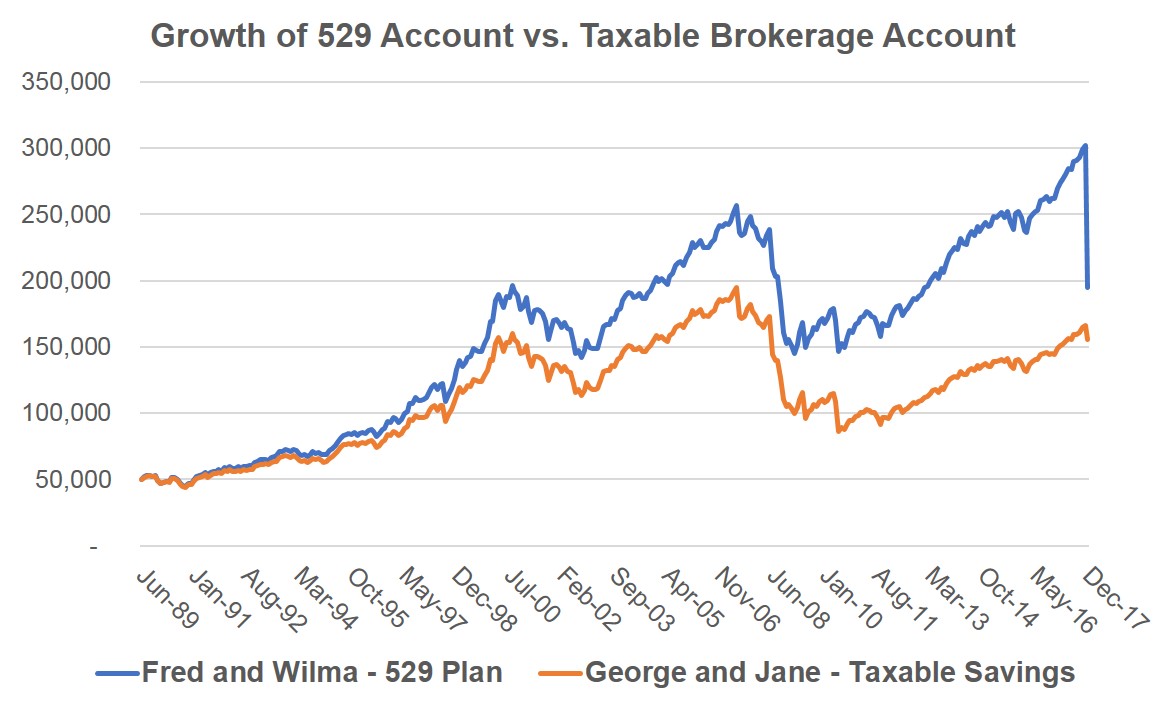
The simply thing Fred and Wilma do for the next xviii years is rebalance in one case a twelvemonth dorsum to the threescore% stocks and 40% bonds. They permit the assets grow and subsequently 18 years, they are ready to start withdrawing $20,000 each year to pay for Pebbles' qualified education expenses. By this point, the original $50,000 has grown to over $256,000. They choose to withdraw $20,000 proportionately from the 2 funds for each year of college and proceed to withdraw $20,000 every twelvemonth for iv years until Pebbles has completed higher.
Despite a horrific stock market sell-off while Pebbles is in college, Fred and Wilma wind upwards with $146,626 afterwards the $80,000 of combined education expenses are distributed. Unsure of what to exercise with the remaining funds in the ii 529 Plans, Fred and Wilma do nil. There's a thought that Pebbles may nourish graduate school just he never does.
Vii years after Pebbles graduates from college, in December 2017, Fred and Wilma retire. By this indicate, the remaining 529 Programme balance has appreciated to over $300,000. Knowing by now that Pebbles has no more than schooling left, Fred and Wilma elect to liquidate the excess 529 funds and splurge on a lake motel. They're forced to pay taxes and a 10% penalty on the earnings portion because it is a not-qualified distribution. Still, after paying the taxes and penalization, they have $194,514 remaining to spend on their cabin.¹
George and Jane save for college
Now consider an alternating universe with parents George and Jane and their son, Elroy. Both scenarios are identical with ane of import exception. George and Jane are concerned near the restrictions of a 529 Plan and the penalties for withdrawing money for non-qualified expenses. As a consequence, they elect to open up a regular brokerage account instead of a 529 and fund it with the same $50,000 in 1989. Everything else is identical – they buy the same 2 funds, in the same amounts, at the same fourth dimension, and they rebalance annually in the same way. So they look 18 years, withdraw $20k per twelvemonth for four years of college, pay taxes, and go along the remaining funds invested until their identical retirement date – December 31, 2017.
When George and Jane retire on the same day as Fred and Wilma, they get to their brokerage account to withdraw all the remaining funds that they didn't spend on Elroy's higher. Their balance subsequently paying capital letter gain taxes? $155,454. Not bad for a lake cabin but 20% less than what Fred and Wilma had remaining.
Fred and Wilma overfunded their 529 Programme, had to pay taxes and penalties, and still came out way alee. Why? The tax advantage of the 529 Programme was and so beneficial compared to the culling that it overwhelmed the taxes and fees that had to come out at the end.
George and Jane had identical returns but each time a dividend, involvement, or a capital letter gain distribution was paid by the fund, they had to pay taxes. They also often had to pay taxes when they rebalanced each June. These tax dollars added up with their high tax rates, leaving less invested for the futurity. Moreover, when they withdrew money to pay for Elroy'due south higher expenses, they not only had to withdraw $20,000 for each yr of college but besides had to pull out additional funds for the capital gain taxes that they owed. As a result of this tax drag, George and Jane accept dramatically less money invested when Elroy finishes higher than do Fred and Wilma.
The chart below shows what the two scenarios await similar, with the example starting in June 1989 and running through December 2017². Notably, the large drop in the blueish line at the finish of the time menstruum represents the taxes and penalties owed for the non-qualified 529 Plan distribution.
Now, what if the original scenarios stay identical with one change – neither Elroy nor Pebbles ever goes to higher. Consequently, in that location are no qualified distributions for the 529 business relationship and at the end of 2017, every dollar of growth in the 529 business relationship is subject to taxes and fees. The result is that the 2 parents end up with about identical amounts – Fred and Wilma with $297,344 and George and Jane with $298,444.
Endmost Comments
In a 2017 commodity, we made the case that 529 Plans take far more than flexibility to get excess funds out without penalty than people realize. Since nosotros wrote it, Congress added fifty-fifty more than flexibility by allowing 529 Plan funds to be used for elementary or secondary school education costs (upwards to a $x,000 per twelvemonth, per beneficiary limit). We also wrote this commodity last year to discredit the mutual reasons for not aggressively funding 529 Plans.
Today's article is only intended to demonstrate the powerful math of tax free growth and how overfunded 529 Plan accounts, fifty-fifty subsequently the fees and taxes for non-qualified expenses, are withal likely to come out on peak. Our communication once more is to not let a lack of agreement or misconceptions virtually 529 Plans go on you from exploiting the opportunity. If you are a parent in the fortunate position of existence capped out on taxation-favored retirement accounts and trying to figure out where to optimally relieve the next dollar, we would again contend that the tax advantages and flexibility of 529 Plans make them dramatically underutilized by high income earners.
¹A state+federal tax rate of 40% was applied to pre-retirement income and a 20% rate for capital letter gains and qualified dividends. A state+federal taxation rate of 30% was applied to the retirement 529 distribution. Rebalancing happened each June 1st.
²Interestingly, the 529 Plan advantage for Fred and Wilma could have been even greater if they took i simple pace when they initially funded the $50,000. Had they opened one account for the $30,000 stock investment and another account for the $20,000 bail investment, they would take concluded with more than dollars due to the revenue enhancement advantage of using two accounts instead of one. As with nearly 529 Plans, CollegeAmerica charges no account fees and so there is no actress cost to have ii accounts rather than one.

Share This Story, Choose Your Platform!
Source: https://rpgplanner.com/529-plan-opportunity/
Posted by: schroederjace1953.blogspot.com
0 Response to "Can You Put Too Much Money In 529"
Post a Comment